


Those not born in Basilicata often discover them by chance. Hanging outside a country house, entwined in long red necklaces swaying in the wind, or crumbled over a plate of steaming pasta. I dried raw peppers are not just any ingredient: they are a way of cooking, of preserving, of waiting. Understand how to use dried peperoni cruschi means approaching a gastronomic culture that has made simplicity a form of respect.
In Lucania, we do not speak of written recipes, but of gestures handed down. Every family has its own way, every kitchen its own rhythm. Here we try to tell their story, without forcing it, as would those who have always seen those peppers grow.
What dried raw peppers really are
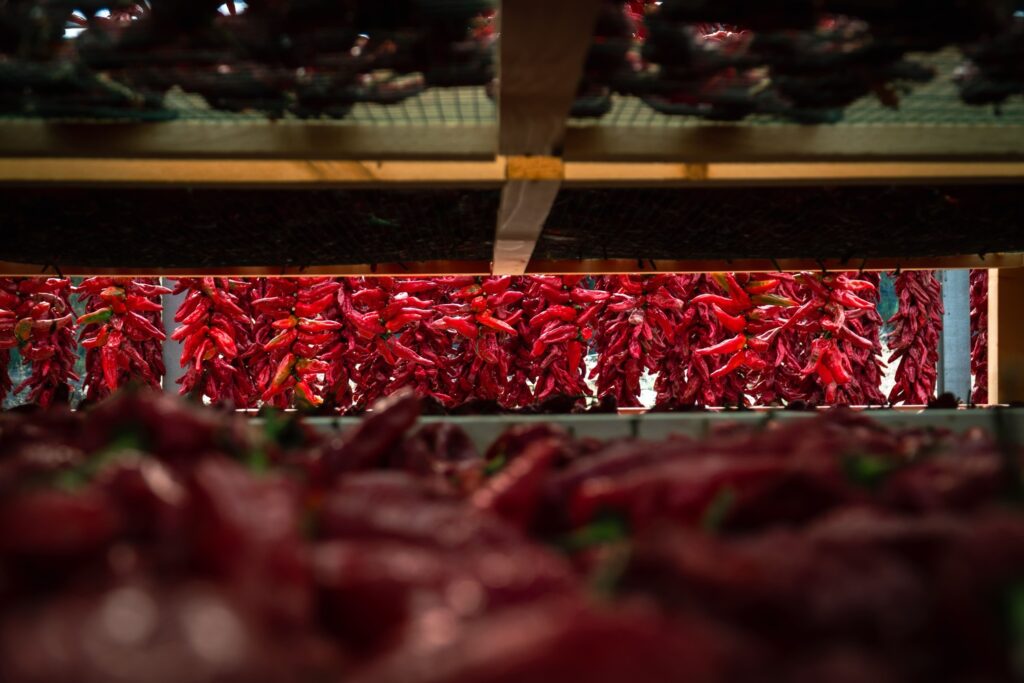
Dried 'peperoni cruschi' are sweet peppers typical of Basilicata, grown mainly in the Senise area and along the Sinni valley. After the summer harvest, when they are ripe and bright red, they are tied by hand and left to air dry, without invasive treatments. The sun and wind do the rest.
The word “crusco” comes from the Lucanian dialect and means crunchy. But this crunchiness is not immediate: the dried pepper, such as it is, is flexible. It only becomes crunchy when it is heated in the right way. This is where experience comes into play, the kind that is not measured by the timer but by the eye and the smell.
What makes the difference is above all the craftsmanship. Agricultural realities such as Tenuta Padì, deeply rooted in the Lucania region, continue to follow these traditional methods, respecting natural times and seasonality. It is an approach that can be found in the flavour, with no need for explanation.
How to prepare dried raw peppers before using them
Before understanding how to use them in dishes, one must learn how to handle them. This is a crucial step, because one mistake at this stage can jeopardise everything.
Fast frying, as it has always been done
Il metodo più tradizionale per usare i peperoni cruschi secchi è la frittura rapidissima. In Basilicata si dice che “il peperone va solo spaventato dall’olio”. L’olio extravergine deve essere caldo ma non fumante. La qualità dell’olio è importante: prova L‘Olio 100% EVO Multicultivar. Il peperone va immerso per pochi secondi, girato una volta e subito tolto. Bastano davvero due o tre secondi. Appena cambia consistenza e diventa lucido, è pronto.
If it stays too long in the oil, it becomes dark and bitter. If the oil is not hot enough, it does not become crude. It is a balance that is learnt over time, by observation.
Lighter alternative methods
Not everyone likes to fry, and that is understandable. Dried raw peppers can also be used in other ways. Warming them in the oven for a few minutes or passing them quickly in a non-stick frying pan still allows you to activate the fragrance and make them crispy, although in a slightly different way. The result is more delicate, but remains true to the product.
How to use dried peperoni cruschi in pasta dishes
In Lucanian cuisine, dried 'peperoni cruschi' find one of their most authentic expressions in pasta dishes. Here, there is no need for complex elaborations: you just need to understand when to add them and how much to use.
One of the most classic examples is pasta with toasted breadcrumbs and crumbled “peperoni cruschi”. The pasta, often homemade, is seasoned with good oil, crunchy breadcrumbs and, only at the end, the pepper crushed by hand. You don't blend, you don't dose precisely. One adds 'just enough', as one has always done.
They also work very well with legumes and cereals. A dish of chickpeas or lentils, perhaps cooked slowly, changes completely when a handful of chopped dried peperoni cruschi is added on top. The softness of the legume and the crunchiness of the pepper create a simple yet profound balance, typical of Lucanian peasant cuisine.
Dried peppers in traditional main courses
Chi pensa che i peperoni cruschi secchi siano solo un contorno si perde una parte importante della tradizione. In molti piatti lucani hanno un ruolo centrale, soprattutto quando si parla di secondi. Un pratico esempio sono le nostre Scaglie di Peperone Dolce Crusco, una spezia non piccante, artigianale.
The best known case is that of salt cod. In Basilicata, salt cod is a historical ingredient, and the combination with dried peperoni cruschi is almost natural. The pepper serves to balance the flavour of the fish, to sweeten it, to give it rhythm. It is not an aesthetic addition, but a fundamental part of the dish.
They also go very well with eggs, white meats and mature cheeses. A fried egg with a few cracked peperone crusco peppers on top is one of those dishes that tell of everyday cooking, made up of a few good things. With a caciocavallo or a pecorino from Lucania, on the other hand, the pepper becomes a contrast that cleanses the palate.
Using dried cruschi peppers creatively, without distorting them
In recent years, dried cruschi peppers have also found a place in more contemporary cuisine. The secret, however, is always the same: don't overdo it.
Reduced in Powder, diventano un condimento naturale molto interessante. Basta sbriciolarli o frullarli brevemente da freddi per ottenere una granella profumata, perfetta per rifinire un piatto senza coprirlo. Una vellutata di patate, una crema di legumi o una semplice ricotta fresca acquistano profondità con un gesto minimo.

They also work surprisingly well in cold dishes. A burrata, mozzarella or potato salad becomes more complete thanks to the crunchy and sweet note of the dried crusco pepper. It is a modern use, but consistent with its nature.
Why craftsmanship makes the difference
Not all dried peppers are the same. Artisanally processed dried peppers have a thin skin, a bright colour and a recognisable aroma, even when raw. They are the result of unforced cultivation, slow drying and a short supply chain that puts the territory at the centre.
Lucanian agricultural producers such as Tenuta Padì represent this way of working, in which quantity never comes before quality. It is an approach that does not need to be explained at length: you can tell when the pepper, once heated, becomes light and fragrant, with no aftertaste.
Who wants find out more on this way of cultivation and processing can observe how the end result on the plate changes.
How to store dried peperoni cruschi
Storage is also part of the tradition. Dried raw peppers should be kept in a dry, well-ventilated place, away from humidity. If they are whole, it is best not to seal them in airtight containers. The air keeps them healthy.
Once fried or toasted, however, they should be consumed immediately. It is at that precise moment that they express their full fragrance. They are not made to wait, but to be enjoyed at the right time.
An ingredient that tells the story of Basilicata
Using dried raw peppers does not just mean cooking. It means slowing down, observing, respecting. It is an ingredient that demands attention, but gives a lot back. It tells of a Basilicata made of fields, of sun, of hands that tie the peppers one by one.
Who wants learning more about this tradition discovers that it is never about excess, but about balance. And that is perhaps why it endures.
Frequently asked questions about dried peperoni cruschi
How do you use dried raw peppers without frying them?
They can be heated briefly in the oven or in a non-stick pan to make them crispy.
Are dried raw peppers spicy?
No, they are sweet peppers. Their taste is mild and does not burn.
When should they be added to dishes?
Always at the end, to maintain crispness and fragrance.
How can you tell if they are of good quality?
They must be light, thin, bright red and smell even when dry.
How long do they last if stored well?
If kept in a dry place, they can last for several months without losing quality.
Dry raw peppers do not ask for prominence. They only ask to be understood. And it is precisely this that makes them one of the most authentic ingredients of Lucanian cuisine.
