


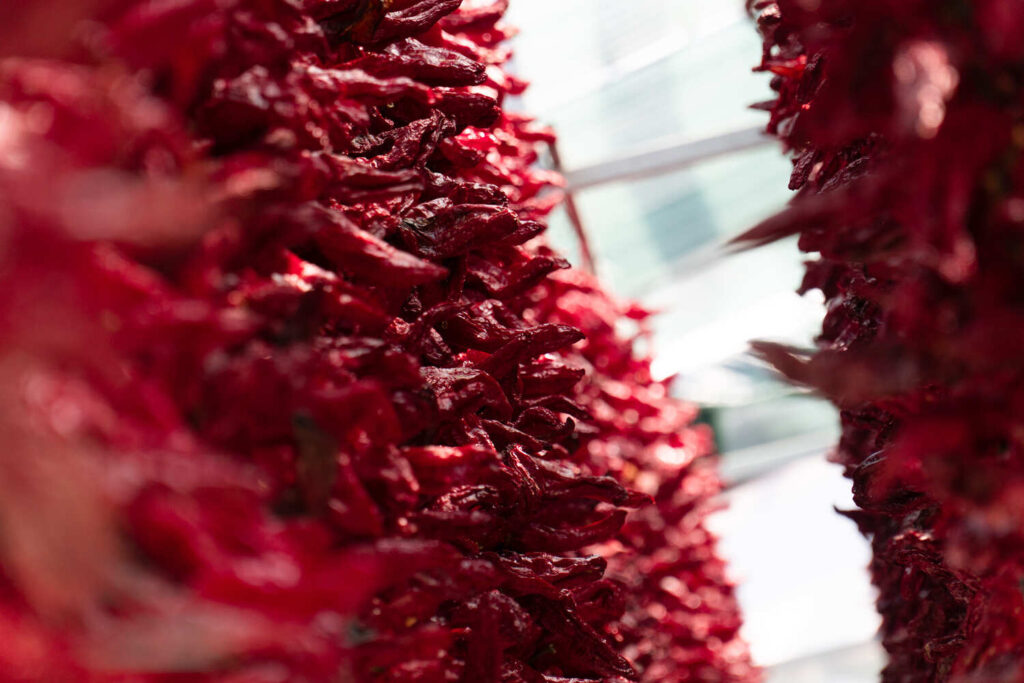
Those who come to Basilicata for the first time often notice them hanging outside the houses, moved by the wind, like little red signs that tell of summer even in the middle of winter. I peperoni cruschi are not just an ingredient: they are a habit, a daily gesture, a way of understanding cooking. Understand how to use cruschi peppers means entering a gastronomic culture of simplicity, attention and memory.
There is no need for complex recipes or technicalities. What is needed is respect for a product that is born slowly, grows with the sun and arrives in the kitchen as it is, without asking to be processed.
What makes cruschi peppers really unique
I peperoni cruschi are sweet peppers typical of Basilicata, grown historically in the Senise area and along the Sinni valley. After the summer harvest, they are tied by hand into long necklaces and left to dry naturally in the air. It is an ancient process that admits of no shortcuts: air does its work, time does too.
The term “crusco” comes from the Lucanian dialect and means crunchy. And this is their most recognisable characteristic. When heated correctly they become crumbly, light, almost impalpable. They do not pinch, they do not burn, they do not overpower. They are sweet, clean, elegant in taste.
It is mainly the processing that makes the difference. Lucanian farms such as Tenuta Padì continue to cultivate them following traditional practices, respecting the cycles of the earth and the natural drying times. It is an approach that does not focus on quantity, but on consistency with the land. Who wants learning more about this tradition realises this from the very first taste.
How to use cruschi peppers without ruining them
Before even thinking about the dishes, it is important to understand how to deal with cruschi peppers. This is where the most common mistakes are often made. The most common method, and also the most faithful to tradition, is quick frying. The oil has to be hot, but not smoking, and the pepper has to be immersed for only a few seconds. Two or three seconds per side is really enough. As soon as it changes consistency and becomes shiny, it should be removed. If it stays too long, it becomes bitter and loses all its magic.
For those who prefer to avoid frying, there are lighter alternatives. Warming them briefly in the oven or in a non-stick frying pan will still give a good fragrance, even if different from the original. The important thing is not to be in a hurry and to watch the pepper: when it is ready, you can tell by touch and smell.
Peperoni cruschi in pasta dishes: when all it takes is a few gestures
In Lucanian cuisine, cruschi peppers are mainly used in first courses, often in very simple preparations. A dish of pasta with good oil, toasted breadcrumbs and crumbled peperoni cruschi tells more than a thousand elaborate recipes. Here the pepper is not a decorative addition, but the element that closes the dish, that gives it identity.
They also work well with legumes and cereals. Chickpeas, lentils, chickling peas or spelt gain character when, at the end of cooking, a handful of hand-split cruschi is added. The contrast between the softness of the dish and the crunchiness of the peppers is one of the secrets of Lucanian peasant cuisine, always attentive to balance.
Not just a side dish: the role of cruschi peppers in main courses
One often thinks of the peperoni cruschi as a simple side dish, but in the Lucanian tradition they can also become protagonists in main dishes. The most emblematic case is salt cod, a poor ingredient that has found a second home in Basilicata. Here, the crusco pepper serves to balance the flavour of the fish, adding sweetness and a crunchy note that makes the dish complete.
They also go very well with eggs, white meats and mature cheeses. In these cases they should never be forced: a few broken pieces on top of the dish is enough. Their task is not to cover, but to accompany.
A more creative use, without losing authenticity
Alongside tradition, today's cruschi peppers also find a place in more modern interpretations. Reduced to Powder, They become a natural condiment that can finish off a dish without distorting it. Simply whisk them lightly when cold to obtain a fragrant grain, perfect to complete a velouté, a creamy potato soup or a simple fresh ricotta. Or the Crusco pepper jam or even our cream of peppers, Condicrusco.

Even in cold dishes they manage to surprise. A burrata, mozzarella or potato salad gains depth thanks to the contrast between the softness and crunchiness of the crusco pepper.
Why choose artisanal cruschi peppers
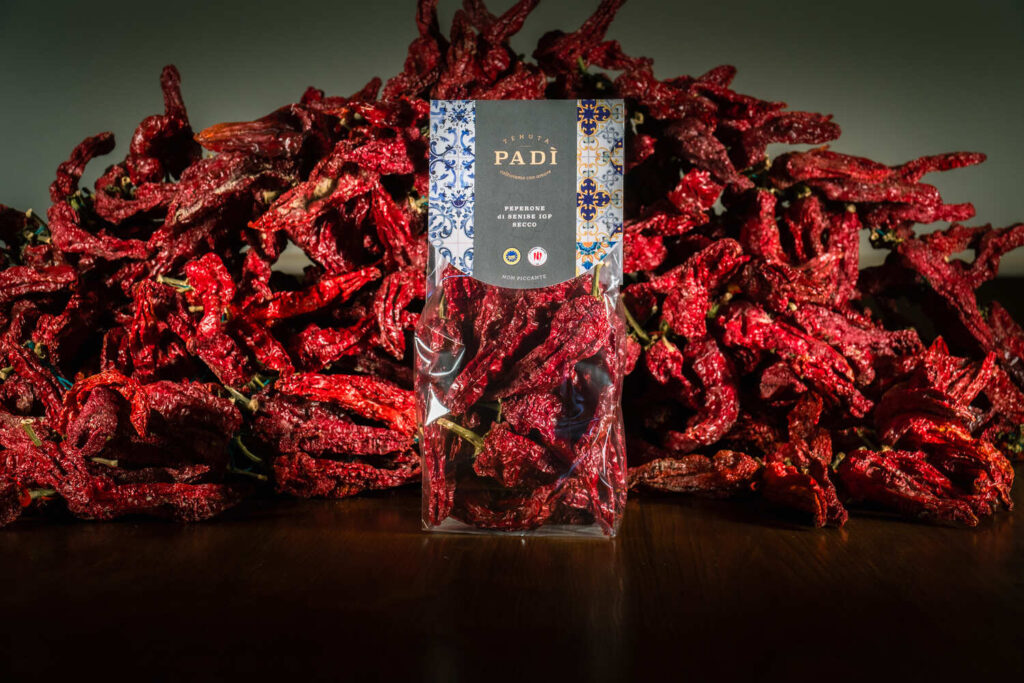
The difference between an artisanal crusco pepper and an industrially processed one is immediately perceptible. The former have a thin skin, a bright colour and a distinct aroma even when dried. They are the result of unforced cultivation, slow drying and a short supply chain that focuses on quality.
Agricultural producers such as Tenuta Padì represent this way of working: a few steps, a lot of attention and a strong bond with the land. No need to say it in words, the product itself tells it. If you are interested deepen this approach, just observe how a dish changes when the ingredient is truly authentic.
How to store them and when to use them
Peppers cruschi should be stored in a dry and ventilated place, away from humidity. If they are whole, it is best not to seal them. Once fried or roasted, however, they should be eaten immediately. It is at that precise moment that they express their full fragrance.
FAQ - The most common questions on cruschi peppers
Are cruschi peppers spicy?
No, they are sweet peppers. Their taste is mild and does not burn.
Can they be used without frying them?
Yes, they can be heated in the oven or in a non-stick frying pan for a lighter result.
With which dishes do they look best?
They are perfect with pasta, legumes, cod, eggs and mature cheeses.
How to tell if a crusco pepper is of quality?
It must be light, thin, fragrant and deep red in colour.
How long do they last?
If stored correctly, they can last for several months without losing quality.
Using cruschi peppers means slowing down, observing, respecting. It is an ingredient that does not ask to be a protagonist at all costs, but one that knows how to tell the story of Basilicata with discretion, dish after dish.
