


In Basilicata there is a sound that is worth a thousand words: crusch. It is the sharp, light sound of the crusco pepper cracking, fragile and fragrant, between the fingers or under the teeth. It is not just a texture, it is a sign of recognition. Preparing crunchy peppers means approaching an ancient tradition, made up of sun, slow waiting and simple gestures that have been repeated for generations.
Understand how to make crunchy peppers the right way is not just learning a technique, but understanding an area and its way of preserving time.
What peppers cruschi really are
Peperoni cruschi are naturally dried sweet red peppers, typical of Basilicata and deeply linked to the Senise area. They are neither an industrial snack nor a fashionable product: they originated as a preservation method, when fresh peppers were processed to last all winter.
The term “crusco” in Lucanian dialect means crunchy. It is a particular crunchiness, light, almost impalpable, which is only obtained when the skin is thin and the drying process is done properly. In the bite, the flavour is intense but clean, sweet, never aggressive.
This uniqueness does not depend on a single factor. It is the result of climate, soil, local varieties and slow processing. In Basilicata, agricultural realities such as Tenuta Padì continue to preserve this balance, following a short and respectful supply chain, where the pepper is not forced but accompanied to its best form.
Which peppers to choose for a real crusco
To make crunchy raw peppers, you first need the right raw material. Not all peppers are suitable. The ideal ones are sweet, elongated, with thin flesh and little water. The best known variety is the PGI Senise pepper, but there are also other local cultivars which, if cultivated and processed correctly, give excellent results.
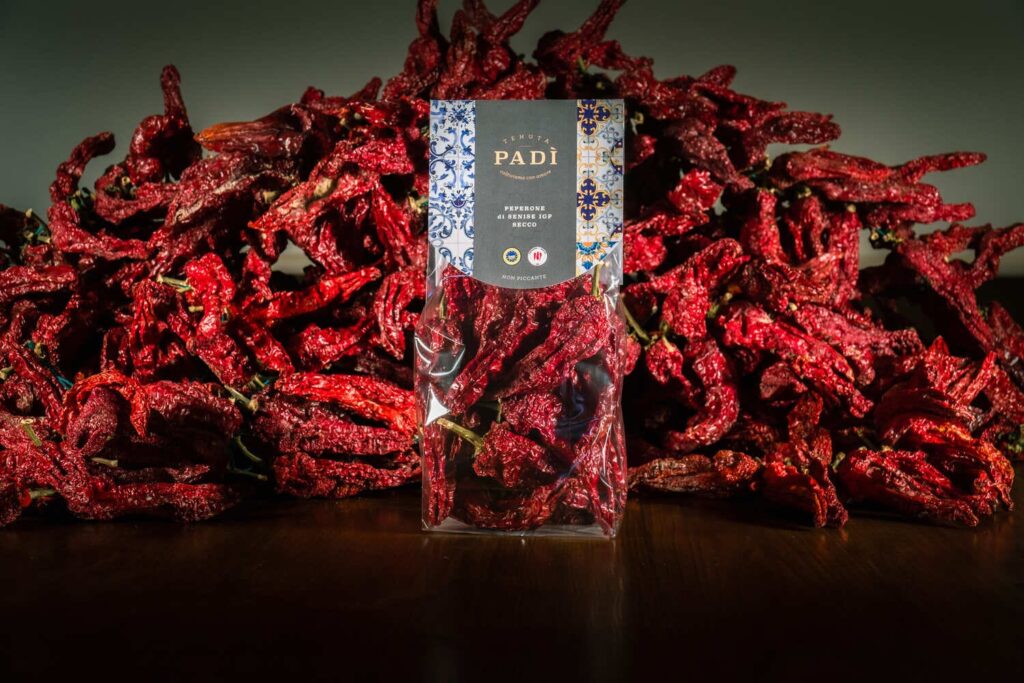
A good crusco pepper is recognisable even when dry: it is light, bright red and uniform, with no dark spots or traces of moisture. It is fragile to the touch, almost crumbly. If, on the other hand, it is heavy or rubbery, it means that it is not completely dried and is unlikely to become really crispy.
Drying: the heart of preparation
Anyone who really wants to understand how to make cruschi peppers must start with the drying process, which is the real decisive step. In Basilicata, it has always been done in the sun, taking advantage of the hot days and dry wind.
The fresh peppers are washed, dried and threaded with a needle and string into classic serte, then hung outside, exposed to the sun during the day and protected from humidity at night. The process takes weeks and cannot be accelerated. Only when the pepper is completely dry, light and sound on the move, is it ready.
At home, one can also resort to a low-temperature oven, leaving the door slightly open. This is an alternative solution, which is useful, but never fully restores the nuances of natural drying. The Lucanian sun, in this, remains irreplaceable.
How to fry cruschi peppers without making mistakes
Frying is the most delicate moment. It is here that the dried pepper becomes crusco, but it is also the point at which it only takes a moment to ruin it.
The oil must be hot but not smoking. The pepper should be immersed for a few seconds, one or two at the most. As soon as the surface becomes shiny and slightly swollen, it should be removed immediately. If it remains in the pan too long, it darkens and develops a bitter aftertaste. If the oil is too hot, the peel burns and loses its fragrance.
Once drained on absorbent paper, the crusco pepper should be left to rest for a few moments. Salt, if needed, is only added at the end and in great moderation. The perfect crunchiness does not need to be covered.
The most common mistakes that compromise the result
Many failures arise from minor distractions. Frying too many peppers together lowers the temperature control. Using peppers that are not completely dry prevents true crispness. Salting in the pan or using too much oil alters the final taste.
The preparation of cruschi peppers requires attention and respect. It is a quick gesture, but must be done with awareness, as taught by Lucanian home kitchens.
How to use cruschi peppers in cooking
The cruschi peppers are not just a decorative element, like our Serte di Peperoni Cruschi. In Basilicata, they are the protagonists of historical dishes such as salt cod with cruschi peppers, but also in everyday preparations: scrambled eggs, simple pastas with fried breadcrumbs, poor but full of character side dishes.
Crumbled over a velouté, broken up over a delicate risotto or used to give crunch to a legume dish, they always manage to bring a recognisable flavour without overpowering. The secret is to let them speak for themselves, without covering them with overpowering ingredients.
Why artisanal cruschi peppers are different
The difference between an artisanal crusco pepper and an ordinary one is not immediate, but it can be felt. In the aromas, in the lightness, in the irregular fragility that tells of non-standardised processing.
In Basilicata, farms such as Tenuta Padì continue to produce following natural times and traditional methods, keeping alive a rural knowledge that does not aim at standardisation, but at authentic quality. It is a silent difference, which only emerges when the product reaches the plate.
How to store cruschi peppers
Once ready, the cruschi peppers must be protected from moisture. An airtight container, kept in a dry place and away from direct light, is sufficient. No need for a refrigerator. If stored well, they keep their fragrance and aroma for weeks, ready to transform even the simplest dish.
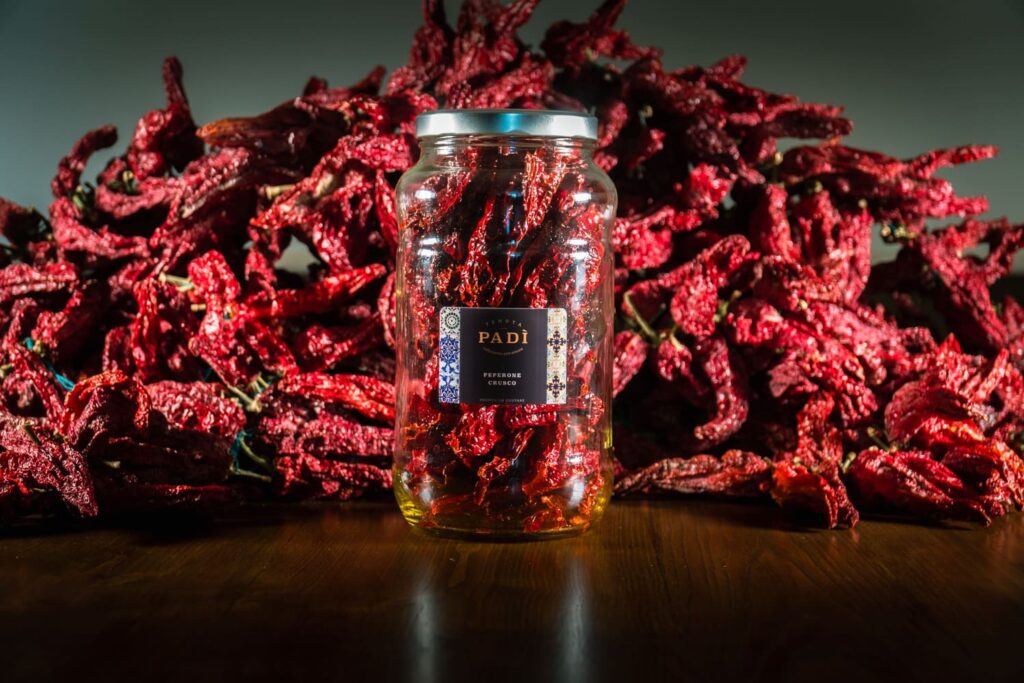
We store many of our products once fried in glass jars like our Crusco Pepper Chips or in an aluminium bag like ours Whole raw peppers already fried in aluminium bag
Frequently asked questions about cruschi peppers
How do you make crispy crunchy peppers at home?
Start with completely dried sweet peppers and fry them for a few seconds in hot but not smoking oil, draining them immediately.
Why do cruschi peppers turn bitter?
It almost always happens due to frying for too long or too high an oil temperature.
Are cruschi peppers spicy?
No, they are sweet peppers. Their taste is intense but balanced.
Can peppers cruschi be baked?
They can be made crispy, but the result will not have the same fragrance as traditional frying.How to recognise quality cruschi peppers?
It has a bright red colour, a light, thin skin and a clean, natural aroma.
