


Whoever hears the word for the first time crusco often ask the same question: what does crusco mean?
It is a term that is not easily found in traditional dictionaries, but in Basilicata it is loaded with meaning, memory and identity. Say crusco means evoking an ancient gesture, a precise sound, a way of experiencing cooking linked to the times of the earth.
In this article, we go in depth: not only on the meaning of the word, but on what it really represents in Lucanian gastronomic culture, on the peperone crusco, how it came about, why it is unique and how it is still used in cooking today.
What “crusco” means: origin and meaning of the word
The term crusco comes from the Lucanian dialect and literally means crunchy, friable, crunching under the teeth.
It does not indicate an ingredient per se, but a consistency, sound and tactile sensation.
In Basilicata they say that a pepper is crusco when, after drying and a very short frying time, it becomes light, brittle and noisy to the bite. Not soft, not rubbery: crusco, indeed.
It is a word born of direct experience, not theory. It not only describes the end result, but a way of dealing with food, of attention, right timing and precise gestures.
What is the crusco pepper
When it comes to crusco, in most cases it refers to the crusco pepper of Senise, one of Basilicata's iconic products.
Not just any variety
The 'peperone crusco' comes from local varieties of sweet peppers, cultivated mainly in the Senise area and along the Sinni river basin. These peppers have specific characteristics:
- thin peel
- non-watery pulp
- sweet and delicate flavour
- elongated shape
These are fundamental qualities to allow proper natural drying and to obtain, in the end, the famous crispness.
From field to crusco: a slow transformation
Collection and serte
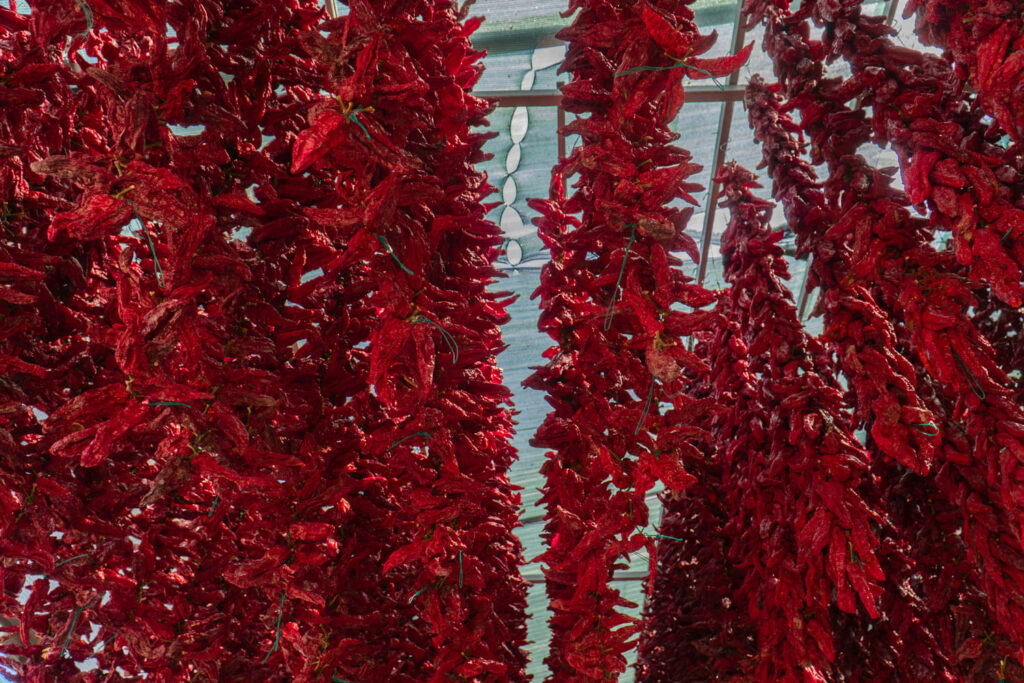
The path to the 'peperone crusco' is not a quick one. After harvesting, the peppers are tied by hand into long necklaces called serte and hung in the open air, often on balconies or under porches.
This is where time comes into play:
sun, wind and patience do the rest.
Drying is natural, without forcing. It can last for weeks. It is at this stage that the pepper concentrates aromas and flavours.
The decisive moment: frying
The moment when the pepper really becomes crusco is frying.
A few seconds in hot oil, no more. A moment's distraction and you burn, losing everything.
When it succeeds, the result is unmistakable:
light, brittle, crisp, with an intense and never aggressive aroma.
It is here that the term crusco takes full meaning.
Why the crusco is so linked to Basilicata
The 'peperone crusco' was not born out of fashion or for the market.
He was born for needs.
In a land historically poor in resources, preserving food was essential. Drying peppers meant having them available all year round, without waste. Frying, on the other hand, was the way to make them palatable, festive, special.
Over time, what was survival became gastronomic identity.
Even today, in Basilicata, the 'peperone crusco' is:
- fixed presence in traditional dishes
- symbol of holidays and important tables
- ingredient that tells the territory more than a thousand words
How to use the crusco pepper in cooking
The great thing about the crusco pepper is that does not need complex recipes. In fact, it is at its best alongside simple dishes.
Pasta and first courses
The great classic is the pasta with cruschi peppers, often combined with fried breadcrumbs, garlic or anchovies. The crusco is broken up over the dish, never cooked with the pasta, to preserve its crunchiness.
One example is the use of
Crispy peppers in glass jars ready to eat fried in extra virgin olive oil, ready to add at the end of preparation.
Legumes and poor dishes
Beans, chickpeas, lentils: humble dishes that change character with crusco. Just crumble one over a hot soup to give contrast, fragrance and depth.
The crusco does not dominate here, complete.
Eggs, meat and vegetables
In Basilicata, it is common to find the 'peperone crusco':
- with scrambled eggs
- alongside roast or baked meats
- over potatoes, stewed vegetables or chicory
It is an ingredient that adapts without ever distorting itself.
Powdered: the crusco as a spice
Another traditional use is the crusco pepper powder, obtained by grinding dried (not fried) peppers.
It is a natural, sweet, fragrant spice used to flavour dishes without covering them up.
An authentic example is the
Crusco di Senise IGP pepper powder.
Crusco and craftsmanship: why it is not an industrial product
The crusco pepper is difficult to industrialise really. It does not like haste, it does not forgive mistakes, it does not accept rigid standards.
Each step - from cultivation to drying and frying - requires attention and manual skill. This is why artisanal production, linked to the land, makes the difference.
Lucanian agricultural realities such as Tenuta Padì continue to process the 'peperone crusco' respecting these balances, following traditional methods and a short supply chain that keeps the link with the land intact.
Who wants learning more about this tradition often discovers that there is more behind the crusco than just an ingredient.
The crusco today: tradition in dialogue with the present
In recent years, the crusco pepper has crossed regional borders, entering contemporary kitchens and even haute cuisine. But its strength remains the same: simplicity, identity, recognisability.
Whether served whole, crumbled or powdered, crusco continues to tell the story of Basilicata without the need for explanation.
For those who also want to delve into everyday uses and ready-made products, there are solutions such as the
Whole IGP Senise Cruschi peppers in glass, already fried
or preparations already processed according to tradition.
FAQ - Common questions on “crusco”
What does crusco mean in Italian?
Crusco means crunchy, crumbly. It is a Lucanian dialect term describing a texture, not just a foodstuff.
Is the 'peperone crusco' spicy?
No. The crusco pepper is sweet. Its flavour is intense but never spicy.
Are Crusco and Senise pepper the same thing?
The Senise pepper is the raw material. Become crusco after drying and frying.
How do you store the 'peperone crusco'?
Dried peppers keep for a long time in a dry place. Once fried, they are best consumed within a few days.
Can the crusco be used without frying it?
Yes, mostly powdered or crumbled. But frying is what gives it its name and identity.
Understand which means crusco means entering a gastronomic culture of slow gestures, respected seasons and recognisable flavours.
It is a small word, but within it is a whole territory.
If you want find out more, just start there: from a pepper, its sound, its history.
